Showing posts with label AdDuplex. Show all posts

Wednesday, February 24, 2016

Just how old are the most popular Windows Phone models?

Last month there was some concern (example) about how the most popular Windows Phone model in use was three years old and that this was bad for the platform, even amongst the Windows Phone faithful. There was a response that showed how the most popular devices are of a similar age on Android and iOS too.

This got me wondering about the age of other devices too.
So I made this graph based on the February stats.


Taking the 40 most popular devices I plotted their age (based on the release date from gsmarena) against their popularity.

What does it show?
Not a lot actually. There is no big link between age and popularity.
It turns out that there is a very small trend indicating a decrease in popularity over time. But this is probably to be expected as people replace older devices and/or they stop working.
It does surprise me that there are so many older devices still in use and in enough numbers to make this chart. (While this only includes the top 40, the data identifies over 200 different models in use.)
The big takeaway, for me, from this charting exercise is a reminder of the importance of testing on older devices. Even very old ones are still in use.


Wednesday, January 13, 2016

Promote your Windows 10 app with AppRaisin - here's why


Have a look at the above graph. It shows the number of downloads for a Windows 10 Mobile app. The app has had no promotion at this point. It was "soft-launched" ready for a big promotional push at the end of January.
There has been one place where this app was mentioned publicly though. On the 8th of January it was included in AppRaisin. Notice what happened on that day--a big spike in downloads.

AppRaisin is a Windows 10 app that helps people discover new Windows 10 apps and games. Anyone can submit an app when it is newly released or updated. This includes the people who have created the app.

Have you built or are building an app for Windows 10? Want more people to hear about it (and hopefully download it)? Then what have you go to lose by submitting it to AppRaisin?


Tuesday, December 01, 2015

Raisin' up app news with AppRaisin

Are you a Windows [Phone] app developer who wants another way to tell potential users of an app about it's launch or major update?
Or
Are you interested in hearing about new and updated Windows 10 apps?
Or maybe you're both.

If any of the above apply to you then you should check out AppRaisin by AdDuplex.


It's like a social news site focusing on Windows app news.

Users decide what news rise to the top by "raising" the apps they like and ignoring the noise. This way enthusiasts get to make sure that top of the crop apps get the attention they deserve and less active users get a curated list of just the best app news.

If you want to discover some of the best new apps then check it, and them, out now.

Download the universal Windows 10 app from the store now.

Tuesday, October 20, 2015

How much would you pay to get another user of your app?

Once you've built an app it's perfectly understandable that you want as many users for that app as possible. But how do you get them?
I regularly hear developers complain that they are disappointed and frustrated that people aren't just finding their app (and installing it) or they're upset that the store isn't promoting their app.

One of the common approaches to user acquisition is advertising. I find that it's common, particularly amongst those with a development background, to underestimate the cost of advertising and have unrealistic expectations about what they can pay to acquire new users.
"$0.10 per new user is far more than I want to be paying" - A developer
To get a feel for what other companies/developers are willing to pay for a new user, I looked at 50 randomly selected campaigns for both iOS & Android from AdDeals and plotted it in this diagram:
(Yes, it's a box-and-whisker diagram. And, no I haven't made one of these since I was in school.)


It roughly tallies with Cost Per Install (CPI) data from Fiksu from last year.

That's an average of between $1.00 and $1.50 per new install.
Yes these figures are for Android and iOS - there just isn't enough Windows data out there that I could. I expect it to be roughly the same situation there though. Sorry if that's what you want. Or if you know of some I'd love to hear it.

So what?

So, consider how realistic your expected figures for what you'll spend to get new users are.

You may be competing for users against people who are prepared to pay. And those who are prepared to pay more will get more ad space.

The above AdDeals figures are based on "non-incentivized" installs. This means that the apps can't offer benefits to users of an app for installing another.
Why so?
Well, would you want someone to install your app just to get a benefit in another app. If that's why they installed your app do you really think they'd become regular users?
Surely you want people to install your app because they want to use it.

Having the people who install your app actually use it is especially important if you're paying for the user acquisition. After all, if people don't use the app how will you monetise their use and recoup the cost you paid for the acquisition?

Why such a range in the amounts above?
Because different apps will be able to earn more from each user. If a user of an app will typically earn the app's creators $9 in profit it's worth spending more to get that user than an app where users typically only earn the owner $1. It's simple economics.


But what if you can't afford or do want to pay for advertising?
Well then you need to consider other ways of attracting new users. Maybe you could consider cross-promotion. ;)


Tuesday, August 11, 2015

Looking at the AdDuplex data differently: Treating variants the same

If there are two variants of a phone: for example one that takes one sim card and the other two; or one version that supports LGT and one that doesn't. Are they really different devices?

Each month, AdDuplex releases stats based on the devices that it serves ads to. You'll find July's stats here.

In looking through the data, it made me wonder if the device variants were really that different. What if we considered the Lumia 520, 521 and 525 as the same. And of course the 630 & 635. And the 530 & 535. etc. etc.
So I rehashed the data to combine the Lumia figures ignoring the last number and replacing it with an 'X'

Here's the impact on the top ten most popular devices.
Make of it what you will.


So, it's still all 5's and 6's.
The 64X is higher than I would have expected.
The 1320 is a nice surprise too.

Yes, you may quibble over whether the 640 & 640XL should be considered the same or claim that 928/Icon is more like the 930 than the 920 but here we are. If you can come up with a really convincing argument for me to adjust accordingly I might be persuaded ;)


Wednesday, July 15, 2015

My CTR has gone down - but I'm not concerned

Here's my CTR for the two weeks before and after I switched to real-time bidding for one of my AdDuplex campaigns.


I've dropped from an average of 1.8% to 1.2%. That's down by a third!


Is this a bad thing?

If CTR was what i was most interested in then I'd be concerned.
Many people would be very worried about this change.

However, here's the important thing.
Over the time period I spent the same budget every day and the clicks did this:


For the same budget, the number of clicks went from an average of 184 to 290. That's an increase of 57%. This is a very good thing.

On its own, CTR is a potentially misleading statistic as it doesn't show the whole picture. Without knowledge of the number of impressions CTR is meaningless. A high CTR from a low number of impressions could be a lot less than a low CTR from a very high number of impressions.

My ultimate aim from buying the advertising is to increase the number of downloads I get. Clicks are a proxy for this figure as the store won't yet tell me where referrals come from. Without the store listing changing over this entire period I can assume that the conversion of people clicking on the ad to eventually installing the app has remained constant.

CTR is indicative of a means to an end. Don't be deceived into thinking this is what ultimately matters. It's the return on investment that's should be monitored and in this case that means clicks.


Tuesday, June 30, 2015

AdDuplex has introduced real-time bidding - what this means for you

Last week, AdDuplex have announced the introduction of a bidding based sub-system. If you're an AdDuplex user then you may have some questions about this and what it means for you.

Here, in hopefully simple terms, is what it means to you and what has changed.

Cross-Promotion
If you're cross promoting your app with the AdDuplex control then nothing has changed. This is true whether you've got a Windows or Windows Phone app and if you're using the control directly or through AdRotator or AdMediator.
If you show ads for other apps and in exchange ads for your app are shown in the other apps then nothing changes.

Direct Campaigns
If you've bought direct advertising in an app nothing changes. Any campaigns you're bought will continue in the same way. You can also continue to buy advertising in the same way.

Network Campaigns
This is where things have changed.
Previously, all ad impressions that you purchased cost the same amount.
This made things were nice and simple and you knew what you'd get for your money.

In reality though, some ad inventory is more desirable than others. This could be ads in some types of apps and people in some locations.
When something is more desirable it is reasonable that some people will be prepared to pay more for it. Similarly it's reasonable to want to pay less for something that other people aren't as interested in.

The way that advertising platforms account for the varying relative value of different impressions is via real-time bidding or RTB. (RTB article on Wikipedia)
This is what AdDUplex has changed to using for paid network advertising.

What this means for you is that:
  • Some ad impressions will cost more.
  • Some ad impressions will cost less
  • You can expect to get more impressions for your money
  • If you want specific targeting for your ads you may end up getting fewer impressions for your money but they should be more valuable to you and therefore something which will convert better. (If you're targeting correctly.)


Practically, what does this mean for you?
If you are currently running paid network campaigns you can switch them to be RTB based.
If you do this before July 7th 2015 you'll get your current balance doubled!
If you don't do this manually, all accounts will be automatically updated on January 1st 2016.

As per the instructions on the blog post, to make the switch, log in to your account and go to "Buy ads –> Billing –> Add credits" then follow the instructions to convert your credit.
The day after you do this you'll be able to adjust your campaign(s). Just go to the bottom of each campaign and adjust as appropriate.


I'd suggest keeping the old daily budget and starting with a low bid (e.g. $0.99) and then adjusting based on performance once you see what you get with those settings.


Thursday, April 23, 2015

Windows Phone OS version market share changes since January 2014

I've been looking back over the AdDuplex monthly reports (the latest is here) and wanted to have a way of seeing how the OS version usage has changed over time.
I came up with this:


All figures are from the reports posted on http://blog.adduplex.com/

It looks like some of those WP7 devices were really built to last.


Saturday, March 28, 2015

Interpreting the statistics in the AdDuplex monthly report


Every month AdDuplex, the leading cross promotion network for Windows Phone and Windows Store apps, releases a report with statistics on devices running apps that have their advertising controls embedded. You'll find the latest one (for March 2015) on their blog at http://blog.adduplex.com/2015/03/adduplex-windows-phone-statistics.html

*disclaimer - if you didn't know, I'm a paid advocate for AdDuplex and help in preparing the report*

As happens every couple of months, there has been some discussion about the relevance and completeness of the data used to prepare the report.
I want to address some of these points and add some clarification over what the report actually shows.

Firstly, let's be clear on what the report is.
The report is an analysis of the devices used to show ads from the AdDuplex network on a particular day. It does not attempt or claim to be an analysis of all Windows Phone devices in use worldwide.

If it's not a complete picture, what's the point of the report?
The report serves three purposes:
1.  To provide information to developers who are or are considering using the network.  This was the ultimate aim when the report was first published. To help developers. After all helping developers to best promote their apps is one of the core aims behind AdDuplex.
2.  To raise the profile of the company. Because no one else is publishing such reports this is the best view of the device landscape available and so is newsworthy in appropriate circles.
3.  It’s better than nothing. Without this report, how would you know which devices are actually in use? At best you'd rely on anecdotal evidence or data collected from a smaller sample set.

It's the first point that is most important!
With this information developers can be aware of which devices are most likely to be used to run their app. It's really easy to assume that other people are like you and, just as much as anyone else, developers often fall into this trap.
In general, most developers I speak to who have and use a Windows Phone have a higher spec device. At the moment they're mostly the Lumia 930, 1020 or 1520. Based on this it would be easy for developers to only think about such devices and how their app looks, performs and behaves on such.
However, through looking at the data in the report it is clear that the majority of devices in use are not like these. 60.8% of devices in use are Lumia 5XX and Lumia 6XX devices. These devices have smaller, lower resolution screens and less powerful processors. Without paying attention to it, the experience of apps across different devices can change and be less than desirable in some instances. For this reason it is important to check apps on different devices. This is even more important when the majority of [potential] users are on such low spec devices.

But this still isn't representative of all devices!
There's an argument that people who pay more for a device are less likely to be tolerant of ads in their apps and so won't use them or will pay to remove them. The corollary of this being that people who pay less for their device have less disposable income and so are more likely to be tolerant of having ads displayed in their apps. This argument is based on anecdotal evidence at best as is also likely to be skewed by cultural biases as people in some parts of the world are more tolerant of ads and readily accept them.
Whether the opinion or anecdotal evidence reflects reality or not, this is a point that needs to be addressed.
AdDuplex are not able to answer this question, don't attempt to and for the sake of informing the people who are using their network it doesn't matter.
- Due to the way that the data is gathered, from apps that are displaying ads, it is not possible to report on devices running apps that don't show ads.
- The report is clear is saying it shows data based only on devices running apps that contain their ad control.
- If you're a developer looking to show adverts in your app then the devices of people who don't use apps that contain ads are not as relevant.

For those of you who are particularly interested, here’s an official comment from AdDuplex on this matter:
The accuracy of the stats we gather is obviously affected by a lot of factors. These range from differences in incomes in various countries to accessibility of mobile internet to the effect of bigger apps and games that we have and the audiences that they target. An argument that people with higher end phones are more likely to buy paid apps is probably correct on a logical level, but it doesn’t mean the opposite – people who are likely to buy paid apps are not less likely to use free apps too. People who are “allergic” to ads come in different shapes and forms of personal income and device preferences (not everyone who can afford an expensive phone necessarily buys one). On the other hand the argument could be made that more of the owners of cheaper phones don’t have access to mobile internet (or have a limited/expensive access) making them less likely to see the ads in apps. More people who buy cheaper smartphones necessarily use them as one (never download any apps at all). It is also worth noticing that not all of the apps and games run on 512mb memory devices, potentially skewing the stats in favor of more expensive devices. All-in-all you can have a number of arguments tilting the scales in favor of one theory or the other, but there’s no data to quantify these effects. At the end of the day with data coming from more than 5,000 apps of various types and calibers, I think the results even out quite nicely and, while no statistical report can be 100% accurate, I’m sure we paint a pretty credible picture of the ecosystem as a whole. And I’ve heard off the record confirmation of this from people who’ve seen the “real” numbers.

Wouldn't it be nice to have more?
Yes, from a point of curiosity there are lots of things that it would be useful to know about what devices are in use, where they're used and what apps are used on them.
There are also strategic and tactical decisions that could be better made with this data.

So why aren't reports with this data published?
The main reason is that the only people with the complete data are Microsoft and there are almost certainly competitive and legal reasons not to release all the data. They have released some in the past (the last was in September 2014 http://blogs.windows.com/buildingapps/2014/09/29/windows-and-windows-phone-store-trends-september-2014-update/) but there is a lot they haven't shared with us.

Could anyone else provide more information?
Possibly. It depends on what data you want though.
If you're just after an analysis of all types of devices in use you need analytics from a publisher (or publishers) who has a free app (or apps) used worldwide.
If you want to compare free, ad supported and paid apps then you need aggregated data of all such apps across all territories you're interested in.

There are probably only a handful of publishers who have sufficient data to provide this analysis.
Other advertising networks or analytics providers probably have the information to produce such reports.
Here's the catch though, there is no incentive or commercial interest for any of them to produce and share such a report so I don't expect any of them to do so any time soon. Should anyone do so, I be as keen to read it as anyone.


It may not be everything that everyone would like but the monthly AdDuplex report provides an insight into what devices are being used by the people who use ad supported apps.
It's also the best public information there is.

Tuesday, February 24, 2015

How developers should think about CPM, CPC and CPI with regards to advertising.

CPM - Cost Per Mille (1000 impressions)
CPC - Cost Per Click
CPI - Cost Per Install

These are the three main ways that in app advertising is bought and sold.
I find that developers are often confused about the differences so let me try and explain.

I'm thinking particularly about adverts for apps here. Specifically as part of a user acquisition strategy.

Let's start by looking at the "user acquisition funnel".


It's a simple concept.
Lots of people see the ad. Some of them click on the advert and then some of them install the app.

With this in mind there are three ways we can get more installs of an app.
1. Get more people to see the advert.
2. Get more people who see the advert to click on it.
3. Get more people who go to the store to install it.

These three ways of increasing installs relate to the three ways of paying for advertising. - Don't be surprised, this isn't a coincidence.


If I want people to see an advert I can pay (CPM) for the advert to be shown. I can pay more for the advert to be seen by more people. I can also, potentially, pay more for the adverts to be displayed to people who are more likely to click on it. In this scenario the person selling the advertising space just needs to provide the space to show the advert. How successful the app is in getting people to click on it is my responsibility as it will come down to how the advert looks and what it says.

If I pay just for the people who actually click on my adverts (CPC) I will expect to pay a bit more but there's a change in responsibility and the relationship between myself and the person selling the advert space. We now both have an interest in the advert being clicked on. For the ad seller the clicking on the advert is the end in itself. For me it's just a means to an end. We want different things from the advert. If I'm creating the advert and it's not as successful as it could be the ad seller is missing out on revenue. If they create the advert it will likely be optimised for getting people to click on it regardless of whether they have an ultimate interest in installing the app or not.

For many people, paying on a CPI basis is appealing as it removes the guesswork and responsibility from running adverts. You don't have to pay for adverts that no-one clicks on, or that are clicked on but don't lead to people installing the app. In this situation you're paying for results and not just things that should lead to the ultimate result you want. As with paying on a CPC there is a conflict in terms of who created the adverts. In that they are being paid for each install that is driven by an advert (the real value of the advert in a CPI scenario is as a way of tracking where the install came from) the incentive to produce the best advert should be on them. After all, the better the advert the more installs the app will get and the more money they'll earn. Of course, it's not just about the advert, how the app appears in the store will also affect if people install the app. Do you let them produce everything in the store listing too? What about all branding, icons and screenshots? Good screenshots that clearly show the value of the app and how good it is can help persuade people viewing the store listing to actually install the app. Taken to its extreme this may mean them wanting to redesign the app so that more people will install it. While this would be good for the app it's not something any ad company is offering. Yes, some will let you advertise on a CPI basis but it's not always the ideal situation it may seem.

All three ways of paying (or charging) for ads each work to serve the ultimate aim of getting more people to install, and hopefully use, an app. Just be aware what you're actually paying for and where the responsibility for success lies.

Advertising your app can be a challenging task but that isn't a reason not to do it though.


Wednesday, February 11, 2015

Create better ads for your apps

As an app developer you're probably not an expert in advertising (I'm not either), but over the last couple of weeks I've been running such an experiment with the creators of  a few apps in store to help us all, hopefully, learn a few things about what makes a good app advert.

Let me start by introducing the apps:
Digi Clock Plus Digi Clock Plus
Digi Clock Plus is all you need whilst at home or travelling to transform your phone into a functional digital alarm clock with fun added extras.
This is one of the most comprehensive clocks in the marketplace and delivers some of the top requested features - photo frame, weather, personalised alarm music and speech.

Grid Ref UTM Grid Ref UTM
Pinpoint your current map reference location anywhere in the world, using the Universal Transverse Mercator geographic coordinate system. (UTM)
App Provides: UTM Grid Ref, Hemisphere, and WGS84 Latitude and Longitude values.
The Accuracy of Readings, as indicated by your device, will also be shown.
Grid Ref UTM - Your Grid Refrence App!

MetroSpec MetroSpec
MetroSpec is a fully featured 16K/48K Sinclair ZX Spectrum emulator for Windows Phone.
Relive the 80's & early 90's by playing the classics, on the 8-bit micro that, kick started the home computer boom.
The ZX Spectrum was an 8-bit computer released in 1982, as the successor to the ZX81. Based around a Zilog Z80 CPU, 48Kb of RAM, 16Kb ROM, beeper sound, rubber keyboard, and tape loading, the ZX Spectrum was a true classic, and now you can relive the experience, bring back your old memories, or beat that final boss you found so hard before.

Night Chopper Night Chopper
Silly and weird little chopping game! Tap tap tap, and chop down that tree under the moonlight to nice piano sounds. The viewpoint is bottom-up, and you have 4 positions to chop from. Avoid those sharp branches!

Yaht 3D Yaht 3D
If you like Yahtzee then this game is for you!
Yaht 3D is based on the dice game called 'Yacht' which is the predecessor to Yahtzee.
Play this simple and fun game against your friends in hotseat mode or try to beat the phone.
Yaht 3D takes advantage of the performance of the Windows Phone to bring you accurately simulated dice rolls. See the 3D dice leap out of your phone, spinning, colliding and tumbling under the forces of gravity.

Each of the above apps are currently available in store and are part of the AdDuplex cross promotion network.

For the experiment we ran two versions of an advert for each app for a week to see how different wording would impact how successful the ad was in persuading people to click on it.

To keep things simple all ads were text ads.
If you're not familiar with how these work: "Text ads are automatically animated to show blocks of 2 lines at a time. Line 1 and 2 are displayed together on one panel of the ad and lines 3 and 4 on the second panel."

Here are the ads we used:

Digi Clock Plus
Option 1     Option 2
Digi Clock Plus
all you need whilst at home or travelling
transform your phone into a functional digital
alarm clock with fun added extras
   
Digi Clock Plus
Free app
transform your phone into a functional digital
alarm clock with fun added extras

Option 2 produced a CTP that was 13% higher.
The only difference between the two ads is the second line. Highlighting that the ad was for a free meant more people clicked on the app.


Grid Ref UTM
Option 1     Option 2
Grid Ref UTM gives you UTM Coordinates, Zone,
and Hemisphere information, on your Windows Phone
Know where you are with UTM / MGRS information
simply presented, on your Windows Phone handset
   
Never get lost again, thanks to your phone
lookup your current UTM location, zone..
..hemisphere, and latitude/longitude coordinates,
simply presented, on your Windows Phone handset.

Option 2 produced a CTP that was 6% higher.
There's not a lot in it but the more successful option is shorter and starts with a clear description of the value the app provides. "Never get lost again" is easier to understand than "gives you UTM Coordinates......" and makes it clearer what the app can do for the potential user.


MetroSpec
Option 1     Option 2
Love Retro gaming? Love 8-bit?
Relive the 80’s
MetroSpec
Sinclair ZX Spectrum Emulator
   
Remember the good old days?
Manic Miner, Sabrewulf, Highway Encounter
Play them again, and more, with MetroSpec
Sinclair ZX Spectrum Emulator

Option 1 produced a CTP that was 2% higher.
It's hard to draw a conclusion from this as while the two ads are different they were both equally effective. They didn't just produce the same level of results they were amongst the highest of all the ads listed here.


Night Chopper
Option 1     Option 2
Night Chopper
tap tap and chop down that tree!
Night Chopper
avoid those sharp branches!
   
Night Chopper - FREE and downloaded by 250.000!
Relaxing game with beautiful piano songs
Nigh Chopper - Rated 4.5 stars by 2.000!
Listen to anime, TV/movie themes++ while playing

Option 1 produced a CTP that was 15% higher.
This result actually surprised me. In adverts, at least, showing how many downloads the app has had, or the ratings it's been given didn't lead to more clicks.
The more successful advert was simpler and, I think, intriguing.


Yaht 3D
Option 1     Option 2
Yaht 3D
Like Yahtzee? Try this 3D dice game.
Yaht 3D brings ultra realistic dice physics
Download full game for FREE!
   
Yaht 3D
"A fascinating and beautiful game" - 5 stars
Tap here to download
"I am hooked. This game is so much fun :-)" - 5 stars

Option 1 produced a CTP that was 8% higher.
As with Night Chopper, highlighting the star ratings that other people have given it didn't lead to better results.
Also, as with Digi Clock Plus, highlighting that the app is free was a successful strategy.


Summary
So, to recap, what have we learnt from all this?
I think we can draw the following recommendations:

  • If you're advertising a free app make sure that you highlight this in the ad.
  • Having less text in an ad is better than having more text.
  • Have a clear value proposition. - Make it clear what will people get from your app.
  • Don't bother focusing on how good other people thought the app was by listing your reviews and number of downloads. Tell people what's in it for them.


Hopefully these tips will help you improve the copy in the ads for your apps.
I'd encourage you to test whatever text you use in your ads though.

If you're in the UK, already have an app in the AdDuplex cross promotion network and are interested in me running some ads for your apps on your behalf please get in touch. The only deal is that you agree to me sharing the results of the test like above.
What have you got to lose?


Monday, February 02, 2015

Thursday, January 29, 2015

What makes a better ad for your app?

Do you advertise your app? Have you integrated cross promotion of your app with AdDuplex?
How did you come up with the copy you use in your ad? Have you tried testing different versions of your ads to see which is more effective?

This is just what I've been doing with a number of developers recently. We've run two versions of an ad for one of each of their apps to see which is more effective and what we can learn from that.

I'll post the full results of the experiments soon but for now lets try a little test. Consider these two options.

Option 1
Option 2


Which option would you choose?
Which option do you think more people would click on?

Let me know what you think, in the comments or on twitter, and I'll tell you which did better soon.


Wednesday, January 28, 2015

What developers should take from the monthly AdDuplex reports

As they've been doing since 2013, this week AdDuplex released their monthly report showing some statistics on Windows Phone device usage.

Here's the most important thing it contains for developers:

Most people (more than half) who use a Windows Phone use a lower spec device.

However, in my experience:

Most developers who use a Windows Phone have a higher spec device.
And, most developers only have one device

There's a disparity here. Does it matter that developers are using devices that are, potentially, very different from the ones their users are using? I think it does.

To ensure an app works well on a lower spec device (or one with a smaller screen - if you have one with a large screen) it's important to test on such a device.
The emulators are good but real devices are better.
If you don't have a low spec device, find someone who does and ask them to let you borrow it.
Alternatively, and fortunately, the lower spec devices are cheap. If you're building apps to make money then it's a small investment to buy one.

Very few developers have access to a wide range of devices. A table like can be seen below is not the norm. Don't be disheartened though. For the most part, as a developer, you don't need this many devices to test on.
My suggestion is that if you're getting devices for testing and you can only afford two, you should get one with the highest spec and one with the lowest spec available. A Lumia 930 and a 520 are probably the most appropriate options right now. If you can get more than this, then I'd consider something with a larger screen, like the 1320 or 1520.


How many devices do you test on?


Tuesday, January 27, 2015

Why you should always set an end date on your advertising campaign

If you've ever advertised on AdDuplex you've hopefully had an email that contains the following:
Thank you for advertising on AdDuplex!

Your AdDuplex campaign has come to an end. Please visit the client area to extend the campaign or start a new one.

Why is this important?
It's important because you'll get an email like this when you reach the end date of your advertising campaign.

So, why is having an end date important?
If you don't set an end date for your campaign it will run until you run out of credit. (If you later top up your credit without disabling the campaign it will start again automatically.)

The real reason though, is so you don't forget about your campaign.

You should not just start your campaign and forget about it, or ignore it.
At the very least, setting a short end date will mean you get an email telling you the campaign has finished. When you receive this you can go and look at the statistics of the campaign, see how successful it was, make appropriate adjustments and then restart it.
Of course you can analyse and adjust before the campaign ends but I find that having an end date set acts as a useful buffer in case something comes up and I forget to check.

I'm guessing that you'd consider yourself a developer more than an advertising expert. As such I think it's fair and reasonable to assume that the copy you write for your advert(s) won't automatically be the best converting copy it could possibly be. As such you'll need to experiment to find what works best for you.

Don't just create your campaign and leave it. Experiment with different copy. Try different  value propositions and calls to action. Try things out. Measure what works and evolve your adverts.
You should be able to improve your CTR with relatively little work.

Some more on this soon....


Monday, January 19, 2015

Windows (Phone) app analytics

I was recently asked what the "best" analytics solution out there is for universal apps.

Unfortunately I haven't reviewed what options are available recently. In the work I do for other people they already have made the decision about what analytics solution they want to incorporate.
There are lots options available and what you'll want to use will depend on the actual analytics you want to gather and what you want to do with them.

Here, in no particular order, are the 3rd party app providers I'm aware of:


There are a couple of other options too:

If you're using an ad solution that guarantees 100% fill rate then the number of ads served can be a good indication of the number of people using the app. It's the most basic level of analytics there is, but it comes for free. ;)

The last option (and the one I'm integrating into what I'm building in my rare moments of free time) is to integrate the analytics into the back-end of the application. Doing this is more work but has a few advantages:

  • No extra requests need to be made by the app
  • No managing a 3rd party component and service
  • Able to get exactly (and only) the information wanted 
  • Much easier to integrate with CRM systems
  • No need to reconcile data from a 3rd party with own data


Monday, December 22, 2014

"House Ads" vs AdDuplex

Microsoft has recently released what it calls "house ads" these are a way to promote one of your apps from within another.
This might sound very similar to what's possible with AdDuplex* so let's look at the similarities and differences between the two.

House Ads are a way of having PubCenter show ads for your other apps if it doesn't have any paid ads to show.
AdDuplex is a cross promotion network that allows you to show ads for other apps and in exchange they show ads for yours.

So, you see, there's similarity in that they both allow you to show ads for your apps.

Let's look into the similarities and differences in a bit more detail though.


Similarities
  • Both are free for developers to use and integrate
  • Both support integration with Ad Mediator and AdRotator
  • Both work well as a fall-back for when no paid ads to display
  • Either could be used on their own to just show non-paid ads
  • Both must have a network connection to be able to serve ads.


Differences
  • House Ads only works with PubCenter - some people don't like this
  • House Ads is a Microsoft product - some people take comfort in this (knowing it's from a big company). AdDuplex is independent and grew out of the community.
  • House Ads Provides a mediation capability without having to use a mediation/rotation tool.
  • House Ads are capped (at 5) per user per day so users won’t experience "ad fatigue" from seeing the same ad repeatedly - AdDuplex doesn't need this as it has a wide variety (1000's) of apps to show ads for
  • House Ads can only be used by accounts that have multiple published apps. AdDuplex can be used even if you only have one app in store/
  • House Ads are only available in limited markets (http://advertising.microsoft.com/en/blogpost/129472/microsoft-advertising-blog/announcing-new-capabilities-for-developers-to-promote-their-windows-and-windows-phone-apps) - AdDuplex can be used anywhere.
  • House Ads may be prioritized over paid ads from other ad providers - AdDuplex gives you greater control over this (via Ad Mediator or AdRotator)


So, which should you use?
Simple. Use whatever is best for you, your circumstances and your apps.

My personal opinion:
If House Ads are available to you, then, if you’re already using PubCenter as part of your monetization solution with an existing successful apps and you’re about to launch something new that will appeal to the users of your existing app then House Ads are a good tool to use while your new app is still gaining traction.
For all other scenarios and as a final fall-back in addition to using House Ads in the above scenario, you should always include AdDuplex as part of a multiple ad provider strategy.


* Disclaimer: I'm an advocate forAdDuplex which means that I'm paid (a small amount) to talk about them - but all opinions are my own. Don't be fooled though. I believed and talked about them in a positive way before I became an advocate. That's one of the reasons I became one. If you question my objectivity I'd love to hear why.


Monday, December 15, 2014

Why using just one ad provider is being foolish

So, you've built an app and now want to make money from it. That seems a reasonable desire.
For whatever reason (hopefully strategic, but often for simplicity) you decide to put ads in the app as a way for making money.

All that's good but here's a common mistake developers often make. They only use a single ad provider.

Here's why that's a mistake.
No ad provider will have ads for you to show all the time. No traditional advertiser will always have an advert for you to show every time you request one. This is known as the fill rate. It's typically shown as a percentage and is the number of ads delivered divided by the number of adverts requested.

There are variations by country, user and type of app, but for most mobile advert providers, to get a fill rate of 40% from a global app is very good. It's often common to see rates as low as 10%.
That means that for every 10 times you want to show an advert (and be paid for doing so) you can only show (and be paid for showing) between 1 and 4 adverts.

There's a simple solution to this though. When one ad provider doesn't have an ad to show, "fall back" to use another ad provider and ask them for an ad. And so on and so on.

Fortunately there are tools that can help you do this. The two main ones in the Windows world are AdRotator and Ad Mediator.
Both will let you specify a list of ad providers to use and the order in which they should be contacted.

Here's how Ad Mediator visualize the process:


This is all well and good, but what about when none of the ad providers you're using have an ad to show?
There are no traditional ad providers who always have an ad for you to show (100% fill rate) and even when you integrate all the advertising providers there are there will still be times when none of them have an ad for you to display.

This is where AdDuplex comes in. AdDuplex* are different from traditional app ad providers in two key ways that are relevant to this conversation.
Firstly, they do have a 100% fill rate. They will always have an ad for you to show. (Subject to network connectivity - but then if the app can't connect to the web then all bets are off.)
Secondly, they don't pay you for showing ads. When we're discussing making money from showing ads this might seem like a big issue though. But consider the scenario: None of the ad providers you use have an ad to show, so, rather than letting the space in your app where you would show adverts go to waste you can use it for something else. You can use it to promote your app. This is where AdDuplex is different. It is not a traditional advertising platform, rather it's a cross promotion network. You display ads for other people's apps in your app and they show your ads in theirs. It works on a simple exchange basis. For every 10 ads you show, 8 are shown for your app(s) and the other 2 slots are sold to fund the service.

This is the key then. If you've got space in your app that you have dedicated to displaying ads with the aim of making money then if there are no paid for ads to display, use that space to promote the app itself. This will help you grow the number users of your app and, in turn, the number of paid for ads you can potentially display in the future.


If you're not yet using AdDuplex but wish to start, then register using promo code:
ML10-1OFKNH and you'll get an exchange rate of 90% (compared to the usual 80% for the first 6 months)

If you are putting ads in your app you should be using a mediation or rotation service that includes use of AdDuplex.


* Disclaimer: I'm an advocate for AdDuplex which means that I'm paid to talk about them. Don't be fooled though. I believed and talked about them this way before I became an advocate. That's one of the reasons I became one.


Tuesday, December 02, 2014

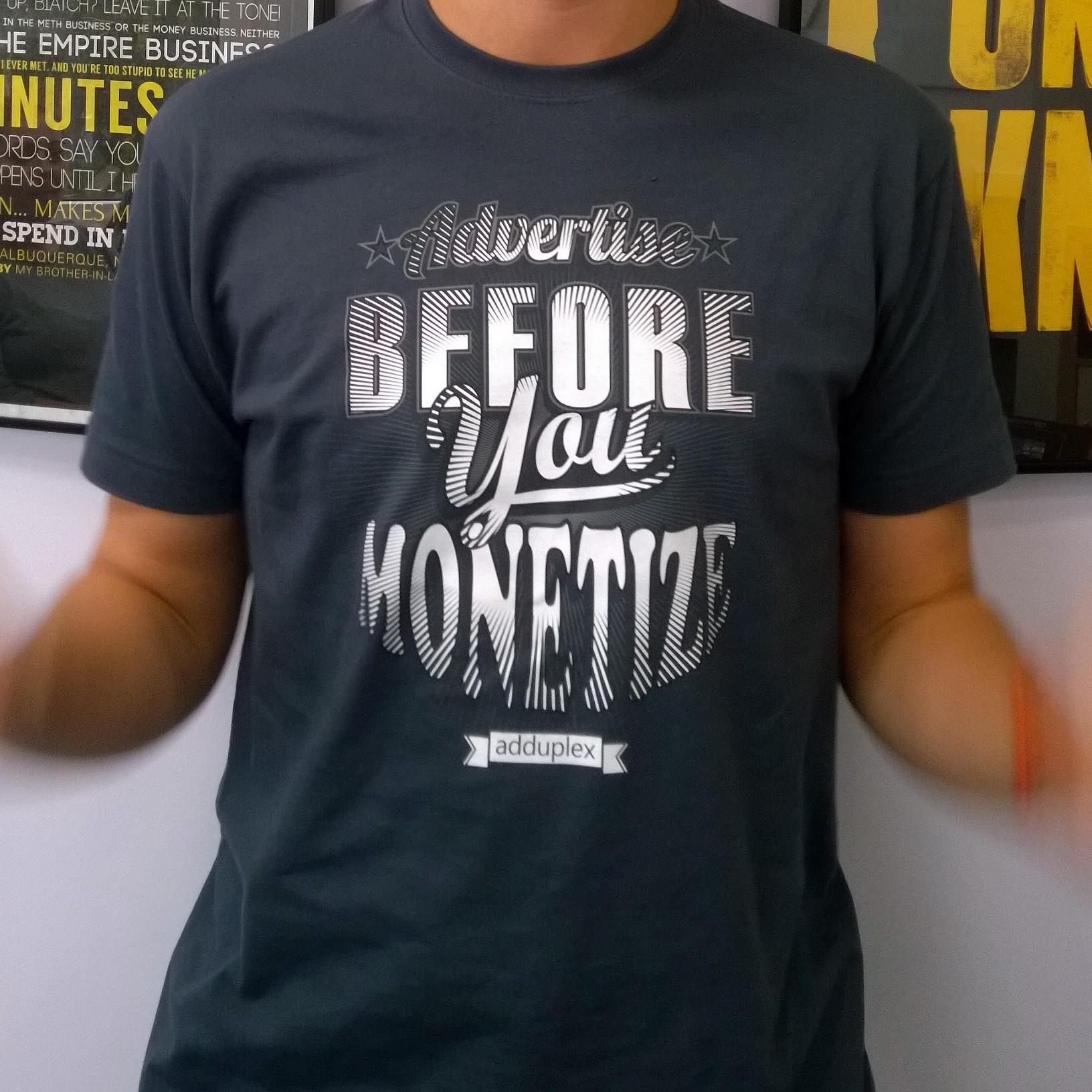
What does it mean to "Advertise before you monetize"?

If you weren't aware, one of the slogans for AdDuplex is to "advertise before you monetize". But what does this mean?


If you've built an app with a view to making money from it, there are two basic options for you.

(There are other options but I'm just looking at the simplest ones here as these are what most developers use.)

Firstly you can charge people directly for using the app. They either pay once, up front, for it (possibly after a trial period) or on a recurring basis. Either as some form of subscription or through the repeated purchase of in app/game consumables or access to more functionality (or levels).

Alternatively, you can indirectly monetize the app based on selling access to the people who use it. This may sound like a strange description or one you've not heard before but that's what you're doing when you put adverts in your app that you are paid for on a CPM basis. From a user/consumer perspective you should be aware that if you're not paying for something you're probably the product.
It can be summed up this way: If people aren't paying to use the app you force them to look at something (an advert) that someone else has paid (or will pay) to show to them.

It's if you're considering using the second approach that the idea of advertising before you monetize is relevant.


If you're income is based on advertising then it's the number of people using the app, and therefore looking at the ads that matters to you.

A common thought process is that having spent time building an app it would be nice to see some return as soon as possible.
There's a problem with this approach though:
You're trying to monetize a small number of users but for advertising to provide a good return you need a large number of users.

This is where the intent behind the AdDuplex slogan comes in.

Rather than using the advertising space in your app to show adverts that you are paid for, use it to help you promote your app and get more users.

This is a great way of integrating the AdDuplex control within your app. You put the control in your app and rather than be paid for showing ads, you exchange the ads you display with adverts for your app being displayed in other apps.

In time, once you have a large number of users for your app you can start to introduce paid adverts as well. Using AdRotator or AdMediator you can have a smart solution for combining paid ads when the provider has one to show, and AdDuplex ads for when the ad provider doesn't have an app to display. This combines the opportunity to make money from adverts and promote the app and get new users so you can make more money in the future.

If you're not already using AdDuplex and would like to start. Email me (adduplex [at] mrlacey.co.uk) and I'll send you a promo code, to use when registering) so you can have even more of your ads shown.

Friday, October 24, 2014

Comparing WP7 stats: AdDuplex and Microsoft

Last month, both Microsoft and AdDuplex released statistics which include figures for Windows Phone 7.X usage.
As a number of developers and companies are starting to think more about how long they continue to support WP7.x devices (I've spoken with a few recently) I thought it was worth looking at this subject in a bit of detail and to consider why the figures from Microsoft and AdDuplex are so different.

Let's start by looking at those figures.

Microsoft claim that "Windows Phone devices running OS 7.x represent less than 5% of all downloads."

AdDuplex (on slide 6) say Windows Phone 7 has a 15.2% share of the OS market.


"15.2" and "less than 5" are quite different. One is more than 3 times the other.
So why could this be?

The answer of course is that I'm not comparing like with like.

Microsoft are reporting that 5% of downloads come from WP7 devices.
AdDuplex are reporting that 15% of app usage is done on WP7 devices.


Downloads and usage are very different.

  • An app is (typically) only downloaded once per user but (hopefully) will be used many times.
  • Due to the nature of the apps that AdDuplex collects data from (ones that show adverts) this may skew the results in favour of devices used over longer periods of time. (Which is a factor that makes showing ads a more viable monetization strategy.)
  • There is an anecdotally supported and widely held opinion that people download more apps when their devices are new. Given that anyone with a WP7 device has likely had it for more than a year I'm surprised it's still this high. (Maybe the second hand market and hand-me-down scenarios are meaning many people are still getting devices that are new to them.)

So, should you still support WP7 devices?
Let's look at some scenarios:

If you're building a new app that needs WP8 specific features then you obviously can't.

If  you're building a new app that doesn't need WP8 specific features then it comes down to considering whether the opportunity to have your app available to 1 in 20 more people is worth the effort (of development, maintenance, support, etc.).

If you have a WP7 app that you're considering dropping support for then it will come down to the potential costs and impact of any potential future problems or issues anyone using the app may have.

If you have a WP7 app that you're considering removing from the store then it will come down to whether you actively want to stop 1 in 20 people potentially downloading the app. Note that this will also prevent people from uninstalling and then reinstalling the app. I know some people use this a documented solution to some issues and so may be an issue.

If you have a WP7 app that you're considering disabling then it will come down to the potential costs and impact of stopping some people from using the app. Hopefully you've got analytics in your app to tell you this. If you haven't then AdDuplex's figure of 15% is very close to numbers I've seen for apps that have been around for about 3 years.


Of course this isn't a complete list (technical issues and commercial pressures can also have an impact) but hopefully this covers the majority of scenarios.